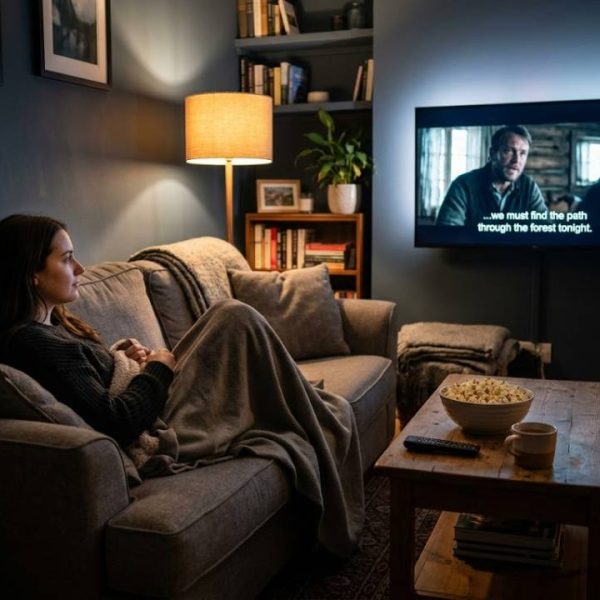

Many viewers still switch subtitles off, convinced that they spoil the picture or slow the story. In reality, subtitles often make television shows and films easier to follow, more enjoyable and even good for learning a language. This article explains why more people are turning them on, and how to get the most from them.
Subtitles help you catch every line
Modern sound mixing favours music and effects, and quiet dialogue can disappear under both. Fast speech, strong accents and background noise make it worse. Subtitles fill the gaps, so you do not need to rewind or turn the volume up and down all evening.
Reading along does not take away from the story. After a few minutes the eyes adapt, and the text becomes part of the scene rather than a distraction.
A natural way to learn a language
Watching series in another language is one of the most pleasant ways to improve listening skills. Start with subtitles in your own language, then switch to subtitles in the language you are learning, and finally try without any.
Short phrases, slang and idioms stick better when you hear them in a scene and read them at the same time. Pause, repeat a line aloud and note new words. If you wonder which languages demand the most effort, this list of the hardest languages to learn may help you pick a realistic goal.
Accessibility matters for everyone
Subtitles and captions were created for viewers who are deaf or hard of hearing, and they remain essential for them. Good captions also describe important sounds, such as a door closing or music building, so nothing is lost.
Many other viewers benefit too: people watching on a train, parents with a sleeping baby in the next room or anyone in a noisy cafe. A feature built for accessibility ends up helping almost everyone.
What makes a good subtitle
A good subtitle is short, easy to read and timed to the speech. It usually holds one or two lines, with a limit on the number of characters, and stays on screen long enough to be read comfortably. It also keeps the meaning, tone and humour of the original.
Translators often condense sentences, drop repetition and choose natural phrases rather than literal ones. The goal is a text that feels invisible, as if the actors were speaking your language.
The difference between subtitles and captions
Subtitles usually translate or transcribe the dialogue for viewers who can hear the audio. Captions include speaker names and sound descriptions, and they target viewers who cannot hear it. Some platforms use the two words interchangeably, so check the menu to see what is on offer.
Many services now let you adjust size, colour and background. A slightly larger font with a soft shadow is much easier on tired eyes.
How professionals handle subtitling
Subtitling is skilled work. The translator watches the video, writes the lines, checks reading speed and aligns every cue with the picture. A second person then reviews spelling, timing and consistency of names.
Studios and streaming platforms that want to reach new audiences rely on professional translation services to prepare subtitles and scripts that respect culture, humour and tone.
Common mistakes viewers notice
Typical problems include lines that appear too late, text that vanishes before it can be read and awkward word-for-word translations. Wrong names, mixed-up pronouns and jokes that fall flat are also common.
When the quality is poor, many viewers blame the show. Often the real cause is a rushed subtitle job with no review.
Tips for a better viewing experience
Sit at a comfortable distance and adjust the text size once, then forget about it. Turn on subtitles from the start of an episode, since switching in the middle breaks the rhythm.
If a show has several subtitle tracks, try each of them. Some are written for hearing viewers, while others describe sounds. Choose the one that suits your mood and your surroundings.
Subtitles for educators and students
Teachers use films with subtitles to start discussions about culture, history and language. Students can compare the spoken line with the written one and spot differences in register and style.
A short clip with subtitles also works well as a listening exercise. Ask learners to summarise the scene, then watch it again without text and see how much they understood.
Choosing what to watch
Documentaries, comedies, thrillers and animation all offer good ground for practice. Pick something you already enjoy, because motivation matters more than the genre. A familiar story, such as a show you have seen before, also lowers the strain.
Keep a small notebook or a note on your phone with the new words that come up. Reviewing them for five minutes before the next episode builds vocabulary faster than you might expect.
Where to read more
For a concise explanation of the history, formats and standards, see the overview of subtitles.
In short, subtitles make viewing clearer, more inclusive and more educational. Switch them on, adjust the look to your taste and enjoy every line of the story.