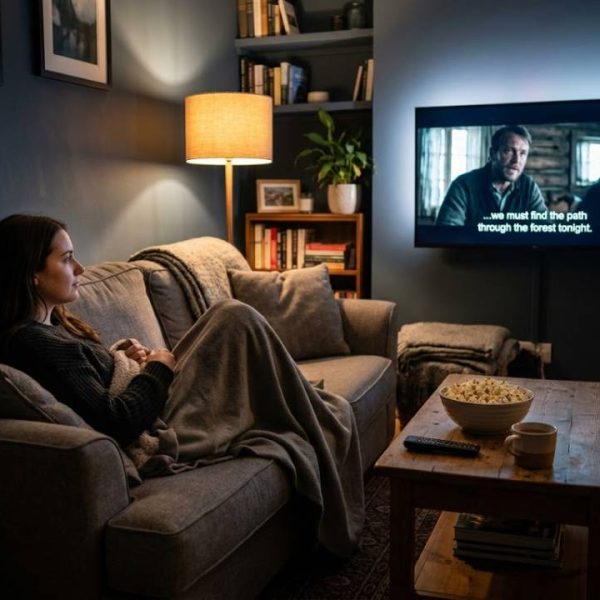
A decade ago, subtitles were mostly for foreign films or people who forgot their remote. Now a large share of viewers turn them on for everything, including shows in their own language. Streaming platforms have quietly turned this niche habit into a mainstream expectation.
Why So Many Viewers Now Watch With Subtitles On
Surveys from major streaming services show that a majority of younger viewers keep captions on by default, often citing mumbled dialogue, background noise, or simply watching on a phone in a noisy room. What started as an accessibility feature has become a default viewing habit across age groups.
This shift matters for studios and streamers because subtitle quality now directly affects how a show is perceived. A clumsy or delayed caption can break immersion just as badly as bad acting.
The Global Reach of Subtitled Content
International hits succeed largely because subtitling and dubbing have improved dramatically. A crime drama filmed in Seoul or Copenhagen can top charts in dozens of countries within days of release, something that would have been unthinkable when subtitles were an afterthought tacked on before a limited overseas release.
Nielsen's viewership research has repeatedly shown that subtitled and dubbed international titles now regularly land in weekly top ten lists across major streaming platforms, a trend that barely existed ten years ago.
Germany's Demanding Audience for Localized Shows
Few markets take dubbing and subtitling as seriously as Germany, where audiences have long preferred fully localized versions of foreign shows over subtitled originals. Getting this right requires far more than word-for-word conversion.
Studios working with German distributors typically rely on certified German translation services to make sure scripts, contracts, and localization briefs are accurate before voice actors ever step into a booth. A show that mistranslates cultural references or legal disclaimers in its German release can face costly reshoots or delayed premieres.
Streaming companies expanding into the German-speaking market often turn to German translation services early in production planning, treating localization as a core part of the release schedule rather than a last-minute add-on.
The Paperwork Behind Every Global Release
Licensing agreements, distribution contracts, and rights clearances all need translation before a show can legally air in a new country. None of this involves creative dialogue work, but it is just as important.
Entertainment companies increasingly rely on certified document translation services for these contracts, since a mistranslated clause in a distribution agreement can trigger disputes between studios and international broadcasters. Certified translation services provide the signed accuracy statement that legal teams require before signing off on cross-border deals.
Why This Gets Overlooked
Fans rarely think about licensing paperwork when a new season drops on their queue, but delays in contract translation are one of the more common reasons international release dates slip.
What Comes Next for Subtitled Viewing
Industry groups tracking film and television trends, including the Motion Picture Association's research division, expect subtitle and localization spending to keep climbing as streaming platforms compete for audiences well beyond their home markets.
Subtitles have changed viewing habits by making foreign-language material feel unremarkable rather than demanding. That shift has quietly raised expectations of language access everywhere else. Patients who watch subtitled drama every evening are far less willing to accept a consultation conducted through a relative, which is part of why medical interpretation services have become a standard commissioning requirement.
Subtitles change how attention is allocated, since reading and listening compete for the same processing capacity. Most viewers adapt without noticing. People already experiencing brain fog often find subtitled content noticeably more tiring, which is a useful diagnostic in itself.
The real story here is that subtitles stopped being an accessibility footnote and became a competitive advantage. Shows that localize well travel further, faster, and earn loyalty from audiences who might otherwise have skipped a title from another country entirely.
For viewers, this means better captions, better dubbing, and a much wider pool of shows worth watching regardless of what language they were made in. For studios, it means localization budgets are no longer an afterthought but a genuine part of how a show gets built for a global audience from day one.
Smaller production houses are taking note as well, often budgeting for professional localization even before a show is greenlit for wide release, since early planning tends to save money and prevent rushed translation work later in the process.
How Streaming Platforms Are Investing in Localization Teams
Several major streaming services have built entire in-house localization divisions over the past few years, hiring linguists, voice directors, and quality reviewers who focus purely on making sure a show sounds natural in its target language rather than simply accurate on paper.
These teams work closely with production well before a show wraps filming, reviewing scripts for phrases, idioms, and jokes that will not translate cleanly. Catching these issues early is far cheaper than fixing a poorly received dub after a global release has already gone out to millions of subscribers.
Smaller Studios Face a Different Set of Challenges
Independent production houses without the budget for a full localization department often outsource this work entirely, which raises the stakes on picking translation partners who understand both language and the entertainment business specifically. A generic translation agency without industry experience can miss context that changes a scene's meaning entirely.
Smaller studios that get this right often see outsized returns internationally, sometimes finding a bigger audience overseas than they ever had domestically, simply because the localized version respected the original tone and humor of the show.